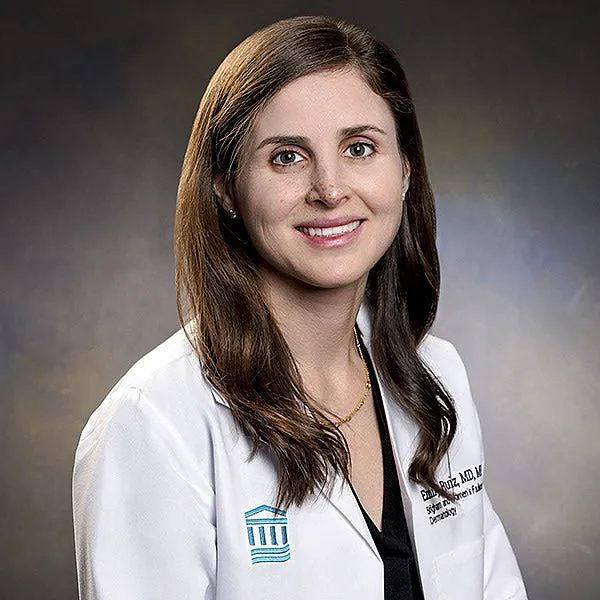
Emily Ruiz, MD, MPH
Brigham And Women's Hospital
Brigham And Women's Hospital
My career is dedicated to patient care, clinical innovation, education, and skin cancer research. I spend 50% of my time in outpatient clinical activities and the remainder of time is devoted to clinical research and education. I have 3 weekly clinical sessions for Mohs and dermatologic surgery at Brigham & Women’s Hospital and 1 weekly clinical session for high-risk skin cancer at Dana-Farber Cancer Institute. I am the Director of the High-Risk Skin Cancer Clinic at Dana-Farber Cancer Institute, which is a regional and national referral program where I provide expert care for aggressive non-melanoma skin cancers and provides skin cancer surveillance to high-risk patients, including transplant patients and individuals with a history of a high-risk skin cancer. I am also the Academic Director of the Micrographic Surgery Center at Brigham and Women’s Hospital. Under this role, I am responsible for the Mohs fellowship, resident rotators, outside rotators, as well as our robust research program which currently has more than 50 active clinical projects. Clinical Expertise and Innovation: My area of clinical expertise is cutaneous oncology for non-melanoma skin cancer. All of my clinical time is dedicated to this field, and my goal is to optimize surgical, non-surgical, and novel approaches to managing skin cancer. The High-Risk Skin Cancer Clinic at Dana-Farber Cancer Institute, which I lead, is the ideal platform for therapeutic advancement. This clinic serves as a referral site for complex non-melanoma skin cancer patients who require multidisciplinary management and not only provides care to patients in the New England area, but also routinely provides second and third opinions to patients from all over the United States and other countries. The clinic is a site for multiple clinical trials for patients with advanced cutaneous squamous cell carcinomas and basal cell carcinomas. I served as the principal investigator for the phase II study evaluated a programmed cell death protein 1 (PD-1) inhibitor for patients with locally advanced and metastatic basal cell carcinomas that failed hedgehog inhibitors. I am also currently the principal investigator for a neoadjuvant study of a PD-1 inhibitor in operable advanced cutaneous squamous cell carcinomas. I am a co-investigator on a number of other clinical trials in cutaneous squamous cell carcinomas, including two adjuvant PD-1 trials. I am also the principal investigator on an investigator initiated prospective study evaluating dermatologist-performed ultrasound in high-stage cutaneous squamous cell carcinomas. This study compares results of the dermatologist performed ultrasound to other imaging modalities, such as PET scans and regional CT scans. I am currently the only dermatologist in the United States who performs ultrasound for lymph node surveillance for cutaneous squamous cell carcinomas. I received training at Charité Hospital in Berlin where I completed a course in ultrasound and then spent one month performing 250 ultrasounds on cutaneous skin cancer patients. The results of this study will be used to inform future cutaneous squamous cell carcinoma guidelines on the appropriate use of imaging in this patient population. In addition to management of high-risk skin cancers, I specialize in field cancerization treatment. This is a disease where patients suffer from diffuse actinic damage and develop multiple skin cancers each year. I utilize treatments that are rarely utilized by other dermatologists. One such treatment is capecitabine, oral 5-fluorouracil, which requires close laboratory monitoring, but is excellent at treating this disease. We offer a number of other therapeutics such as field treatment and oral chemoprevention. Few dermatologists in the country specialize in treating this chronic disease. As part of my work as the Director of the High-Risk Skin Cancer Clinic, I am working to improve multidisciplinary care and the overall patient experience. In March 2020, I launched a multidisciplinary non-melanoma tumor board that has enhanced care of advanced tumors at DFCI. This is a weekly meeting with dermatologists, Mohs surgeons, head and neck surgeons, radiation oncologists, medical oncologists, radiation oncologists, and nursing. This tumor board has improved communications and care coordination and has become essential to the group. In addition, I am working to create a platform for patients and family members with advanced nonmelanoma skin cancers to connect with other individuals with similar diagnoses, support staff, and experts in the field. This will be the first dedicated support network for patients with this disease and will hopefully improve their experience with the additional resources. The remainder of my clinical time is dedicated to surgical management of skin cancer. I specialize in Mohs micrographic surgery and am the principal investigator for a study evaluating intraoperative immunohistochemistry staining with p40 and AE1/AE3 antibody during Mohs micrographic surgery for poorly-differentiated cutaneous squamous cell carcinoma. This stain is not used on frozen sections by any other Mohs surgeon nationally. Given my expertise in aggressive cutaneous squamous cell carcinomas, I assist in the management of both locally advanced and metastatic cutaneous squamous cell carcinoma. This requires performing Mohs surgery on the primary tumor prior to further resection in the operating room with head and neck surgery or surgical oncology. Most Mohs surgeons in the country do not operate on such aggressive tumors, but utilizing Mohs allows for complete margin evaluation and improved outcomes. My clinical expertise has led to multiple invited presentations regionally, nationally, and internationally. For example, I am invited annually to lead sessions on non-melanoma skin cancer management at the American College of Mohs Surgery Annual Meeting and the American Academy of Dermatology. Investigation: My primary research interests mirror my clinical innovation and focus on cutaneous squamous cell carcinoma and basal cell carcinoma. I have published a number of studies on cutaneous squamous cell carcinoma utilizing a large retrospective cohort from BWH and Cleveland Clinic Foundation. Such studies answer important questions on in transit metastatic disease (published in JAMA Dermatology), lymphovascular invasion (published in JAAD), tumor staging (published in JAAD and JAMA Dermatology), adjuvant radiation (under review), and immunosuppression (under review). We are also assembling a retrospective and prospective registry of advanced cutaneous squamous cell carcinomas at five sites across the United States and Europe. This registry will focus on answering important questions on surgical, radiation, and systemic therapy treatments. In addition, we are generating a tissue repository to complement the clinical data in order to focus on translational research. Another area of interest is radiologic imaging for high-stage cutaneous squamous cell carcinomas. There are currently no guidelines for which tumors should undergo staging and surveillance imaging. I have published two pivotal studies in the JAAD, on which showed improved outcomes due to earlier disease detection and the other which showed that imaging, not clinical examination, identified all nodal metastases. I have been awarded a $50,000 grant to study dermatologist-performed ultrasound to monitor for lymph node metastasis for patients with high-stage cutaneous squamous cell carcinoma. We hope to not only validate ultrasound in cutaneous squamous cell carcinoma patients, but also generate data that can be used to develop future surveillance recommendations. I am also currently collaborating with the department of radiology to evaluate radiologic imaging utilization across the United States as well as identify practice variations. I am also assembling a multicenter advanced basal cell carcinoma cohort with Cleveland Clinic Foundation and the University of Pennsylvania. This will be the largest cohort of advanced basal cell carcinomas to date and will evaluate treatment sequencing of surgery, radiation, and systemic therapy. I am also dedicated to advancing knowledge in the arena of cost analysis for skin cancer care. I received a Career Development Award from the Dermatology Foundation and a Cutting-Edge Research Grant from the American Society for Dermatologic Surgery for my study entitled “Skin Cancer Equity and Expenditure Analysis.” I have published studies on skin cancer surveillance (JAAD), the cost of skin cancer care (JAAD), ipilimumab utilization in melanoma (JAAD), and the cost of cancer treatments (JAMA Oncology) utilizing the All-Payer Claims and Medicare databases. I am currently utilizing claims data to estimate the incidence of squamous cell and basal cell carcinomas in the United States.
Emily Ruiz, MD, MPH
Brigham And Women's Hospital