Mouse Engineering Core Spotlight
June 23, 2026
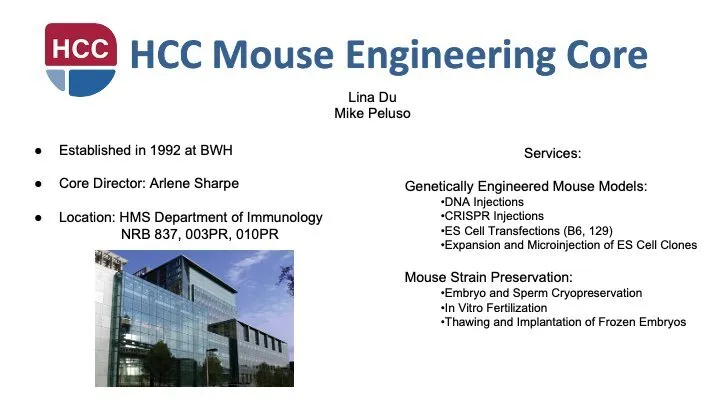
Since its founding in 1992 at Brigham and Women’s Hospital, the Mouse Engineering Core has steadily grown into a central, campus-spanning engine for building and sustaining mouse models that power cancer research across Harvard-affiliated institutions. Originally led by Dr. Arlene Sharpe (HMS), the Core relocated to Harvard Medical School in January 2017 and later that year was approved as an HCC Core in development (October 2017). Its trajectory within the Harvard Cancer Consortium has been marked by strong demand and demonstrated impact—so much so that when the CCSG came up for competitive renewal in 2021, the Core earned an Exceptional merit score after first being introduced to HCC as a developing core in 2017.
By 2024, the Core’s reach reflected both breadth and depth. It supported 5 of the 7 HCC center member institutions and contributed to 9 of 17 research programs. In practical terms, that year the Core delivered 5,741 service units to 37 users working across 26 PI laboratories, with 69% of those PIs being HCC Members. The numbers tell a story of steady throughput, but the day-to-day reality is more personal: investigators arrive with a biological question, and the Core helps translate that question into a workable, trackable mouse model strategy—then helps carry it through the technical steps needed to make it real.
Just as important as generating models is ensuring researchers can use them well. The Mouse Engineering Core maintains an active presence in school-wide events and retreats that spotlight shared resources, while also offering targeted, on-request education for investigators and lab members. This training has been concrete and hands-on: Dr. Lina Du trained members of the Ulrich von Andrian (HMS) lab in making injection needles for tissue injection; trained Kelly Burke and Jonathan M. Li (Arlene Sharpe, HMS lab) in survival surgeries to remove primary tumors and then monitor metastases; and trained Haonan Xu (Arlene Sharpe, HMS lab) on the general surgical workflow at the VSC (formerly NRB) animal facility. Michael Peluso extended the Core’s educational footprint through consultations and broader instruction, including consultation for the Edward Chouchani lab on mouse embryonic cell culture, plus presentations introducing mouse model generation in the HMS first-year PhD course “Experimental Platforms, Design, and Analytics” and at the LMA Research Cores Showcase.
While the Core’s foundation is built on established capabilities, it is also actively expanding. Two recent developments define the near-term horizon:
**New Services**
- The Core plans to expand its service to assist investigators with rederivation of mouse strains.
- In late 2024, we made a capital equipment purchase of a Zeiss SteREO Discovery V20 microscope.
At its center, the Mouse Engineering Core remains a service-and-collaboration hub—one designed to meet researchers where they are, whether they need a new genetically engineered line, help preserving a strain, or technical support at a critical experimental step. Its offerings include:
**Key Services**
- CRISPR Injection services
- ES cell electroporation services
- ES cell injection services
- Fresh/Frozen sperm IVF
- Inducible progenitor stem cells (IPS) injection
- Injection of DNA constructs (BALB C, C57BL/6, FVB) into egg pronuclei for generating transgenic mice
- Lentiviral Injection services
- Sperm/embryo cryopreservation
- Tail biopsy services
- Thawing and implantation of embryos
Taken together, the core's history, measurable utilization, training role, and expanding toolkit, functions as both infrastructure and multiplier: it accelerates model development, improves experimental readiness, and helps ensure that sophisticated mouse-based studies are feasible across the HCC research community.