Here we provide an overview of data sources within the breast department, primarily from clinical trials and clinical databases. Descriptions of the studies and the databases are provided below. If you wish to use these data resources in your research, please refer to the tab on project proposals to submit an application to the Users Committee or OncDRS as appropriate.
Program
Data Sources
Clinical Databases
BOC Clinical Databases
Demographic, clinical and treatment data
Since 1997, a set of academic comprehensive cancer centers have collected clinical, treatment and outcomes data on patients receiving care at their own respective site. These data were originally collected by institutions for internal research/quality reporting purposes, and for an outcomes database project sponsored by the National Comprehensive Cancer Network. The NCCN outcomes database ceased efforts in 2012. This collaborative of cancer centers has now decided to share their individual institutional data for the purpose of establishing a research data repository of patients with newly-diagnosed breast cancer who represent the populations seeking care at each participating cancer center. Hereafter, this new effort will be referred to as the Breast Cancer Collaborative Outcomes Research Database (BC-CORD). Across all of the participating centers in the collaborative, approximately 60,000 patients with 204,423 patient years of follow-up were entered in the database as of March 2013. DFCI contributed 6,806 newly diagnosed breast cancer patients from 1997 to 2012.
Breast Cancer Database
1. Patient ID
Patient Identification Number
Institution Number
2. Baseline
Sociodemographic Factors (Race/Ethnicity, Zip Code, Educational Status, Employment Status)
Medical History (Height and Weight at Presentation, Comorbid Conditions, Menopausal Status)
Past Breast Cancer and Non-Breast Cancer Episodes
3. Diagnosis/Staging
Initial Triggering Event
Initial Staging Tests
Biopsy/Surgery of Primary Breast Lesion
Breast Cancer Type
Clinical/Pathologic TNM
Surgical margins, Histologic/Nuclear Grade, Lymph node involvement, ER/PR status, HER2neu status
4. Therapies
Surgical Treatment and Reconstruction
Radiation Therapy
Chemotherapy, Hormone Therapy, Immunotherapy, Bisphosphonates
Patient Protocol History
5. Follow-up Tests
6. Outcomes
Disease Status
Overall Survival
Disease-Free Survival
Breast Cancer Assessment Periods
12 month CRA assessment
Annually thereafter
2013 – 2015- No data collected during this time period
2016 – Collection of demographic, clinical and treatment data of patients with newly diagnosed breast cancer and received surgery at DF/BWCC and South Shore on or after January 1, 2016.
Data will be collected in the Clinical Outcomes Quality Database (COQD) in RedCAP. As of January 1, 2021, 8,394 patients abstracted who had surgery at BWH/F and SSH on or after January 1, 2016.
- The following clinical information will be collected on each study participant:
- Demographic (age at initial dx, race/ethnicity)
- Primary breast cancer history: stage, histology, grade, hormone receptor status and HER2 status
- Treatment history: adjuvant chemotherapy, adjuvant hormone therapy, adjuvant radiation therapy
- Metastatic breast cancer history: date of recurrent or metastatic disease; location; sites and dates of radiation therapy, dates of systemic therapy (lines of therapy and first and last dose; response). Please note that patients who had surgery and drug therapy elsewhere and subsequently were seen at DFCI for the first time after a diagnosis of metastatic breast cancer was made are NOT included in this database.
- Long-term follow-up data
- Please note that in addition to the breast-specific database, there are efforts underway at Dana-Farber as a whole to collect common data elements across disease centers. The database is currently under construction.
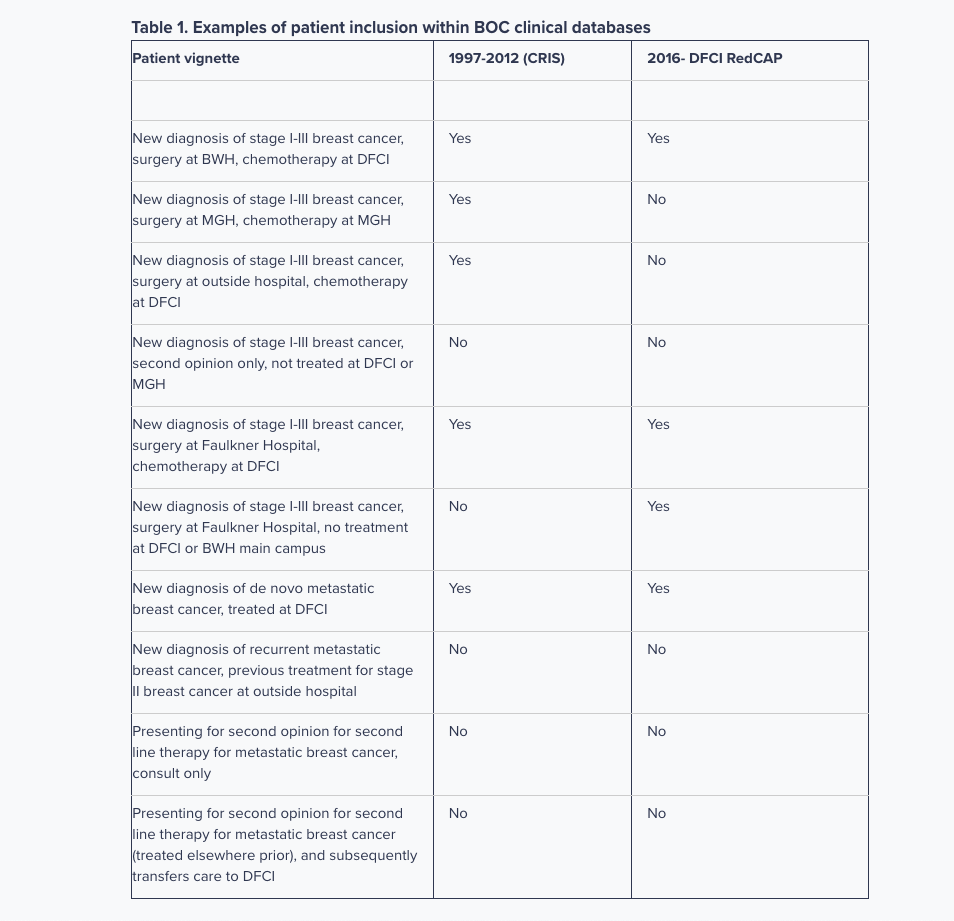
Examples of patient inclusion within BOC clinical databases
- The following clinical information will be collected on each study participant:
Data from OncDRS
On an institute-wide level, various types of data are also available through OncDRS (see below). The table below presents the type and source of data that have data available through OncDRS. All OncDRS data is updated every two weeks and new data elements will be included over time. For more information on specific data elements, please refer to OncDRS Data Guide. Important note: ER, PR and HER2 data, as well as other curated data are not available through OncDRS. In addition, tumor registry data, particularly prior to 2016, do not include the majority of breast cancer patients seen at DFCI.
DFCI tumor registry data, particularly prior to 2016, do not include the majority of breast cancer patients seen at DFCI because the DFCI tumor registry included cases who were seen at DFCI for their first course of treatment. If breast cancer patients are seen and treated at either BWH or Faulkner Hospital prior to coming to DFCI, these patients are included in the other institutions’ Tumor Registries. Starting in 2016, the DFCI Tumor Registry began to include any patient seen at the DFCI at least 3 times to increase the numbers of newly diagnosed patients in the DFCI Tumor Registry.
Data Type and Source(s)
Demographics - Epic
Patient Vital Status - Epic, Cancer Registry
Visit Diagnosis - Epic
Cancer Registry Diagnosis - Cancer Registry
Oncology Medications - Epic, Pre-Epic Pharmacy, Pre-Epic COE, Pre-Epic LMR
Oncology Treatment Plan - Epic, COE
Lab Results – Chemistry & Hematology - Sunquest Lab
Encounters - Epic
OncoPanel Genetic Test Results from Tumor Specimens - CAMD
OncoMap Genetic Test Results from Tumor Specimens - CAMD
11-104 Protocol Consent - OnCore, Epic
Protocol Registration - OnCore
Research Protocols
93-085: Project SHARE (Specimens Help All Research Efforts) Collection of Specimen and Clinical Data for Patients with Breast Cancer or High Risk for Breast Cancer
- Principal Investigator: Nancy Lin, MD/DFCI ( NLIN@BICS.BWH.HARVARD.EDU)
- Overall accrual: 27,824 as of January 2021
- Blood collection includes blood samples are drawn on those patients scheduled to have a blood draw for routine clinical purposes at a time period soon after patient consents. Ten mL blood will be drawn into EDTA containing test tube, and whole blood will be aliquoted into cryovials. Five mL will be drawn into a blue topped tube. Plasma will be separated from cellular component by centrifugation and aliquoted into cryovials. Blood collection is catalogued in caTissue. Note not all patients have a blood sample drawn since patients may not come back to be treated. Only one blood sample per patient is collected at this time after consent and the timing of the blood collection is not based on timing before or after surgery, progression, or treatment switch.
- Additional prospective blood collections have been added since 2017-2018 where timing of blood collection includes draws prior to start of chemotherapy in early stage patients and at time of follow-up visits for those patients who are 5 years from their diagnosis.
- Tissue collection are obtained only when a procedure is planned for clinical reasons and would normally be discarded following routine pathological procedures, mainly among patients with new diagnosis of primary breast cancer. Tissue collection will be catalogued in caTissue. Fresh/frozen tissue will then be banked and stored under the Breast Tissue Bank under Dr. Deborah Dillon.
- 1997 - 2011 –
- No strict eligibility criteria for collection during this time period
- 700-800 breast cancer tumor samples from patients consented under 93-085 to allow for linkage with detailed clinical annotation in CRIS data. Basic retrospective specimen-level annotation in caTissue ongoing and includes pathologic tumor size, number of positive lymph nodes, histologic grade, hormone receptor status, HER2 status
- Approximately 750 anonymized samples collected under Partners #2000P001448. For more information, contact Deborah Dillon directly
- 2015 - present-
- Eligibility criteria - >=1.5 cm and/or neoadjuvant chemotherapy patients with at least >1.0 cm residual disease
- 154 breast cancer tumors collected during 2020
- Basic retrospective specimen-level annotation in caTissue ongoing and includes pathologic tumor size, number of positive lymph nodes, histologic grade, hormone receptor status, HER2 status. Also includes whether specimen was obtained after neoadjuvant therapy and whether it is linked to a specific tissue collection sub-study (i.e. inflammatory breast cancer, clinical trial, etc.)
- DFCI RedCAP
11-104/17-000: Profile - Research on Clinically Acquired Patient Material in Cancer
Principal Investigator – Bruce Johnson, MD ( Bruce_Johnson@dfci.harvard.edu)
Overall Accrual: over 3,000 patients with metastatic breast cancer who have successful OncoPanel tests.
11-104/17-000 (Profile) is the umbrella protocol for clinical data, tissue collection and genomic testing of tumors across DFCI, BWH, and Boston’s Children’s Hospital. Patients have been consented since 2011. There have been different versions of the assay used since 2011. The Oncomap assay was used from 8/01/2011 through the end of September 2013 from DFCI (adult and pediatric), BWH (Adults) and consult patients referred from other hospitals to DFCI and BWH are included. Three versions of OncoPanel tests are included in the database: OncoPanel Version 1 (v1) data includes patients sequenced between 6/26/2013 and 8/6/2014. Oncopanel v1 includes an initial 275 cancer genes and 91 introns across 30 genes for rearrangement detection. Implemented on August 7 of 2014, Version 2 of OncoPanel expands on the initial version to include the exonic regions of an additional 25 genes associated with disease and drug response, intronic regions of an additional 4 genes, as well as other non-coding regions across several other genes. Version 3 of Oncopanel went live on October 4, 2016; Version 3.1 as of March 4, 2018.
All DFCI patients are approached at registration for consent to the protocol. The consent rate, however, has varied and overall within breast cancer patients has been less than 50 percent. The Breast Oncology Center has prioritized approach and consent for 11-104/17-000 in patients with metastatic breast cancer on the clinical floors. Oncomap/Oncopanel testing has been ordered primarily on patients with metastatic breast cancer and the consent rate for these patients is higher, based on targeted consent efforts in the breast oncology clinic for these patients. In addition, it is important to note that because of the targeted metastatic population, analyses examining disease-free survival and recurrence rates are not feasible in the breast cancer dataset.
There are some non-curated clinical data elements that can be linked to Oncomap/Oncopanel results available in OncDRS (for example, age, race, sex, chemotherapy ordered within EPIC), however, detailed curated clinical data, including ER, PR, and HER2 status, and any information from outside records, are not available through OncDRS for breast cancer patients. Other data sources outlined in this document will need to be used to obtain this type of clinical data and use of this data requires formal collaboration with Dr. Eric Winer, Dr. Nancy Lin, and Dr. Deborah Dillon, and approval by the Oncopanel Sub-committee of the HCC Breast Users Committee.
09-204 : EMBRACE: Ending Metastatic Breast Cancer for Everyone
Principal Investigator: Nancy Lin, MD/DFCI ( NLIN@BICS.BWH.HARVARD.EDU)
Overall accrual: 2,711 metastatic breast cancer patients as of January 2021
Demographic, clinical, and treatment data of patients with metastatic breast cancer enrolled in the study and have a baseline blood draw dating from January 8, 2010 to present. The study enrolls patients seen at least once at DFCI for a diagnosis of metastatic breast cancer and who consent to the study. In contrast to the 93-085 databases, patients seen as consults only and patients who received part or all of their treatment at outside institutions may be included in this study, if consented.
- Data is collected in a RedCAP database for patients with metastatic breast cancer disease consented to 09-204, 11-104/17-000, 93-085, and/or 05-246. As of January 2021, there have been 4,147 patients abstracted into the database
- The following clinical information will be collected on each study participant:
- Demographic (age at initial dx, race/ethnicity)
- Primary breast cancer history: stage, histology, grade, hormone receptor status and HER2 status
- Treatment history: adjuvant chemotherapy, adjuvant hormone therapy, adjuvant radiation therapy
- Metastatic breast cancer history: date of recurrent or metastatic disease; hormone receptor and HER2 status; location; sites and dates of radiation therapy, dates of systemic therapy (lines of therapy and first and last dose)
- RECIST response data is NOT available. Archival scans are also not collected nor catalogued prospectively.
- Long-term follow-up data
Blood collection includes:
- For all consented patients, blood is collected:
- At baseline: 10 mL into EDTA tube and 10 mL into CPT tube
- At time of first treatment switch: 10 mL into EDTA tube and 10 mL into CPT tube
- At 4 to 6 weeks after treatment switch: 10 mL into EDTA tube and 10 mL into CPT tube
- In June 2015, all consented patients also had a blood sample at baseline and at each progression event for the analysis of cfDNA (One 10 mL sample in CPT tube) and then blood draws every three months at time of clinical blood draws (Two 10 mL samples into EDTA-containing or CellSave tubes).
Tissue collection: The consent includes permission to request archival tissue specimens for research purposes. At present, no on-site bank of stored archival specimens exists though there are discussions under way to create one.
05-246: Collection of Specimens and Clinical Data for Patients with Breast Cancer
Principal Investigator: Nancy Lin, MD/DFCI ( NLIN@BICS.BWH.HARVARD.EDU)
Total accrual: 888 breast cancer patients as of February, 2018.
This study allows us to collect research specimens in the preoperative, neoadjuvant, and locally advanced and metastatic settings. If a patient has consented to the study, any patient with suspected and confirmed breast cancer at all stages of disease can consent to providing tissue samples by undergoing a research biopsy – either at the time of a clinical biopsy or independent of the timing of a clinical biopsy. The study also allows for serial biopsies to be performed. Biopsy material is fresh-frozen.
In terms of blood collection, samples will be collected to match the time of biopsy for isolation of CTCs, germline DNA and cfDNA. Serial blood draws are available for a subset of patients.
In addition, there is a substudy under 05-246 as part of the Center for Cancer Precision Medicine (substudy being led by Dr. Nick Wagle) that is focused primarily on whole exome and transcriptome sequencing of tumor samples from patients with metastatic breast cancer. Tissue collection will undergo different prioritization processes than those consented under 05-246. In addition to the initial blood draw at time of biopsy, blood collection will also occur at time of first treatment switch, 4-6 weeks after treatment switch and at time of tumor progression and/or at regular three month intervals.
06-169: Helping Ourselves, Helping Other: The Young Women’s Breast Cancer Study
Principal Investigator: Ann Partridge, MD, MPH/DFCI ( Ann_Partridge@dfci.harvard.edu)
Overall accrual (as of January 2021): 1302 young women (diagnosed age 40 or younger) with breast cancer
Study includes blood and tissue collection, medical record abstraction and serial questionnaires (women are surveyed every 6 months for the first 3 years after diagnosis, then yearly after for an additional 7 years). After the initial 10 years we give women the option to continue the survey component for an additional 10 years. Clinical and treatment data is abstracted via medical record review.
- Baseline data fully extracted. Long-term follow-up extraction is ongoing.
- Data is collected in a Microsoft Access database. Some survey data (year 7 is manually entered by staff, years 8,9,10 can be accessed directly by the patient) is collected in Redcap (online survey portal).
- All women have reached at least their 6-year survey.
- Due to COVID-19 restrictions we have made the surveys from the 6-year survey up available on REDCap and we ask women if they would like to take their surveys online versus a paper send out.
- The following clinical information is collected on each study participant:
- Demographic (age at initial dx, race/ethnicity)
- Primary breast cancer history: stage, histology, grade, hormone receptor status and HER2 status
- Treatment history: (neo-)adjuvant chemotherapy, adjuvant hormone therapy, surgical history
- Metastatic breast cancer history data is abstracted based on patient self-reported survey data: date of recurrent or metastatic disease
- Long-term follow-up data
Blood collection includes:
- For all consented and active patients (as of January 21, 2021, of the 1225 eligible, we have at least 1 sample from 92% of our patients. As of 1/21/21, 833 patients have completed their baseline draw, 985 patients have completed their 1-year draw, and 669 patients have completed their 4 year draw.). Blood is requested at the following time points:
- At baseline (Enrollment to 9 months post-dx)
- 1 year from diagnosis (9 months to 2 years post-dx)
- 4 years from diagnosis (3.5 years to 5 years post-dx)
- If collected, 2 (10 mL) EDTA tubes are taken at each time point
- -10 mL tubes yield 6 cryovials
- -4(~2mL each) aliquots of whole blood
- -2(~2mL each) aliquots of plasma
*Note the above time ranges are guidelines. The protocol only specifies that blood will be requested at 3 different time points. There are some existing draws that were collected outside of these ranges.
Tissue collection: for all consented patients (98% of our cohort) we pursue the following: original H&E Stained slides from all specimens and tissue blocks stored in paraffin.
Central pathology review and individuals with tumor blocks banked: As of January 21st, 2021, (1242/97%) and 1120/88%, respectively.
94-138/13-325: SEARCH: Hereditary and Other Risk Factors for Cancer
Principal Investigator: Judy Garber, MD, MPH/DFCI ( Judy_Garber@dfci.harvard.edu)
Overall accrual: over 8000 high-risk patients as of January, 2021
Demographic, clinical, family history information is collected on all participants. Participants meet one of the following eligibility requirements:
- Known cancer susceptibility gene mutation
- Anyone having genetic testing for a known cancer susceptibility gene mutation
- Personal history of multiple primary cancers
- Personal or family history suggestive of inherited predisposition such as young age of cancer diagnosis, multiple primary cancers, or rare growth/malignancies
- Members of a group known or suspected to have increased risk of cancer
Blood collection includes 2 cohorts:
- One-time blood or saliva sample:
- 10 mL EDTA whole blood tube and 5 mL serum into CPT tube
- 2 mL saliva (extracted or unextracted)
- Serial blood draw:
- 10 mL into EDTA tube and 5 mL serum into CPT tube collected every 6 months for up to 5 years
Specimen availability: Greater than 5000 patients have completed a one-time sample and over 80 have completed at least 2 serial sample collections
Tissue collection archived tissue can be collected for any consented patients
10-458: ACT: Tissue Repository for Individuals at High Risk for Cancer
Principal Investigator: Judy Garber, MD, MPH/DFCI ( Judy_Garber@dfci.harvard.edu)
Overall accrual: Greater than 370 high risk patients as of January, 2021
Demographic, clinical, family history information is collected on all participants. Participants meet one of the following eligibility requirements:
- Known cancer susceptibility gene mutation
- Early age of cancer onset (under 30 years old)
- History of high-risk lesions included ADH/ALH
Tissue availability Greater than 300 tissue blocks are available
Tissue collection FFPE and OCT prophylactic breast tissue
11-035: Inflammatory Breast Cancer Outcomes
Principal Investigator: Beth Overmoyer, MD, FACP/DFCI ( Beth_Overmoyer@DFCI.HARVARD.EDU)
Overall accrual: 372 inflammatory breast cancer patients as of March, 2017
Demographic, clinical, and treatment data of patients with inflammatory breast cancer enrolled in the study. The study enrolls patients seen at least once at DFCI since 1997 for a diagnosis of IBC and who consent to 93-085. In contrast to the other 93-085 databases, patients seen as consults only and patients who received part or all of their treatment at outside institutions may be included in this study, if consented.
- 414 patients with retrospective data.
- Data is collected in RedCAP electronic case report form.
- The following clinical information will be collected on each study participant:
- Demographic (age at initial dx, race/ethnicity, family history)
- Primary breast cancer history: stage, histology, grade, hormone receptor status and HER2 status
- Initial presentation of IBC (symptoms and imaging studies)
- Treatment history: adjuvant chemotherapy, adjuvant hormone therapy, adjuvant radiation therapy
- Longitudinal followup: date and sites of recurrent or metastatic disease; hormone receptor and HER2 status; location; lines of systemic therapy
- Long-term follow-up data
12-156: Clinical and Pathological Correlation of Inflammatory Breast Cancer Imaging
Principal Investigator: Eren Yeh, MD/DFCI, BWH ( EYEH@PARTNERS.ORG)
Overall accrual: 414 inflammatory breast cancer patients as of March, 2017
This studyreviews imaging data on the characteristics of inflammatory breast cancer patients treated at the Dana-Farber Cancer Institute. The study enrolls patients seen at least once at DFCI for a diagnosis of IBC, consent to 93-085, are included in 11-035 (the retrospective IBC database), and whose imaging is available through the DFCI/BWH radiology
digital imaging archives since 1997 as part of their routine clinical care. In contrast to the other 93-085 databases, patients seen as consults only and patients who received part or all of their treatment at outside institutions may be included in this study, if consented.