The HCC Continuing Umbrella of Research Experiences Student Training Program New Faces, Same Important Mission
September 30, 2026
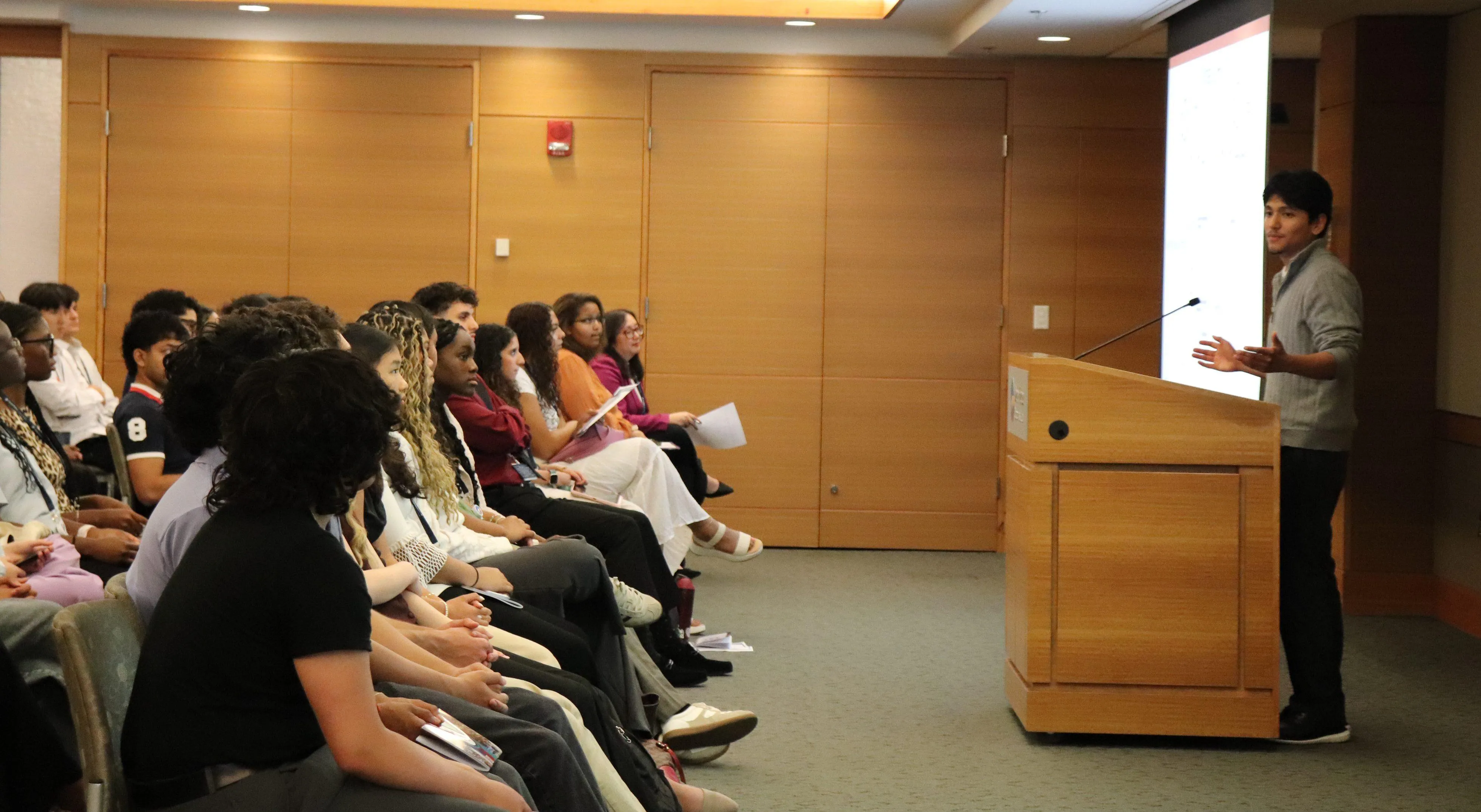
The Harvard Cancer Consortium hosts a long-running student research training program called CURE – Continuing Umbrella of Research Experiences – that pairs high school and undergrad students with Principal Investigators and their labs to gain exposure to research.
In the past year, some new faces have joined CURE’s Director, Brittany Michel, PhD, but the important work of showing students that they too can be cancer researchers continues.
Support the CURE Program
Join the CURE Team for the 2026 Jimmy Fund Walk on October 4th! All funds raised for our team go directly to the CURE program.
New Faces
My name is Teresa Acosta, and I am the Program Manager for the CURE Program. I hold a Master of Public Health from Boston University School of Public Health. Before joining the CURE team, I helped administer summer programs at BMC in partnership with the American Heart Association. I am excited to join the CURE team and contribute to a program that supports students at various stages of their professional journeys. Outside of work, I love to hike, explore new coffee shops, and travel around the country!
My name is Chris Hogan, and I joined the CURE team in May as a Research Training Specialist. I hold a Master of Education degree from Saint Anselm College and have a background in education and cancer research fundraising. This summer, I had the privilege of working with high school and college students as they developed their research skills, explored cancer-focused topics, and created lesson plans for middle school students. Watching students build confidence, engage deeply with their learning, and grow as researchers has been one of the most rewarding aspects of my role. Outside of work, I enjoy running and am currently training for my first marathon this October.
Looking Back at Summer, 2026
While the students' projects spanned topics ranging from immunology and genomics to cancer prevention and bioengineering, their reflections on the summer revealed consistent themes. Nearly every student emphasized the importance of mentorship. Student Cali Cahill spoke warmly about a mentor who immediately made her feel welcome and helped her overcome feelings of imposter syndrome as a first-time researcher. Student Jeronimo Palacio echoed that sentiment, describing a laboratory environment that felt more like a family than a workplace and expressing gratitude for mentors who patiently guided him through complex scientific concepts and encouraged him when mistakes occurred. Student Josue Venegas credited his mentor with introducing him to entirely new skills, including coding and data analysis, while helping him develop tools he expects to use throughout his academic and professional career.
While the contributions of the lab PI and scientific mentors simply could not be replaced, many students highlighted the unique opportunities created by Brittany and the CURE team, including networking events, professional development workshops, admissions panels, and connections with peers who shared their interests in science and medicine. Student Emma Foster described the program as exceptionally well organized, praising everyone from mentors to seminar facilitators for their commitment to student success. Student Jameel McDaniel noted that activities such as the Hale Reservation retreat, medical school admissions discussions, and community-engaged research programming broadened his perspective on healthcare and research. Venegas, a first-generation immigrant student, emphasized how valuable it was to learn the often-unspoken expectations of professional research environments and to receive guidance that might otherwise be unavailable to students from underrepresented backgrounds.
Across every interview, gratitude emerged as the defining theme. Students thanked their mentors for investing time, patience, and encouragement in their development, and they thanked the CURE team for opening doors to experiences that helped them imagine new possibilities for their futures. Whether discovering an entirely new field of study, building confidence in a laboratory setting, developing technical expertise, or forming lasting connections, the students consistently described CURE as a transformative experience that expanded their understanding of both science and their own potential within it.
Just as importantly, their stories highlight the extraordinary commitment of the scientists, clinicians, postdoctoral fellows, graduate students, and research staff who chose to welcome students into their laboratories. Throughout the interviews, students repeatedly credited their mentors not only with teaching scientific techniques, but also with creating supportive environments where questions were encouraged, mistakes became learning opportunities, and young researchers could envision themselves pursuing careers in science and medicine. By opening their labs and sharing their expertise, these mentors helped turn curiosity into confidence and provided experiences that will shape students' educational and professional paths for years to come.
As another successful summer comes to a close, the students' accomplishments serve as a reminder that the future of cancer research depends not only on scientific discovery, but also on the willingness of today's researchers to invest in the next generation. The CURE program thrives because of scientists who dedicate their time and energy to mentorship, and the reflections shared by this year's students make clear that their efforts have a lasting impact. On behalf of the CURE program, heartfelt thanks go to every mentor and host laboratory whose generosity, guidance, and commitment made these experiences possible.
Student Highlights
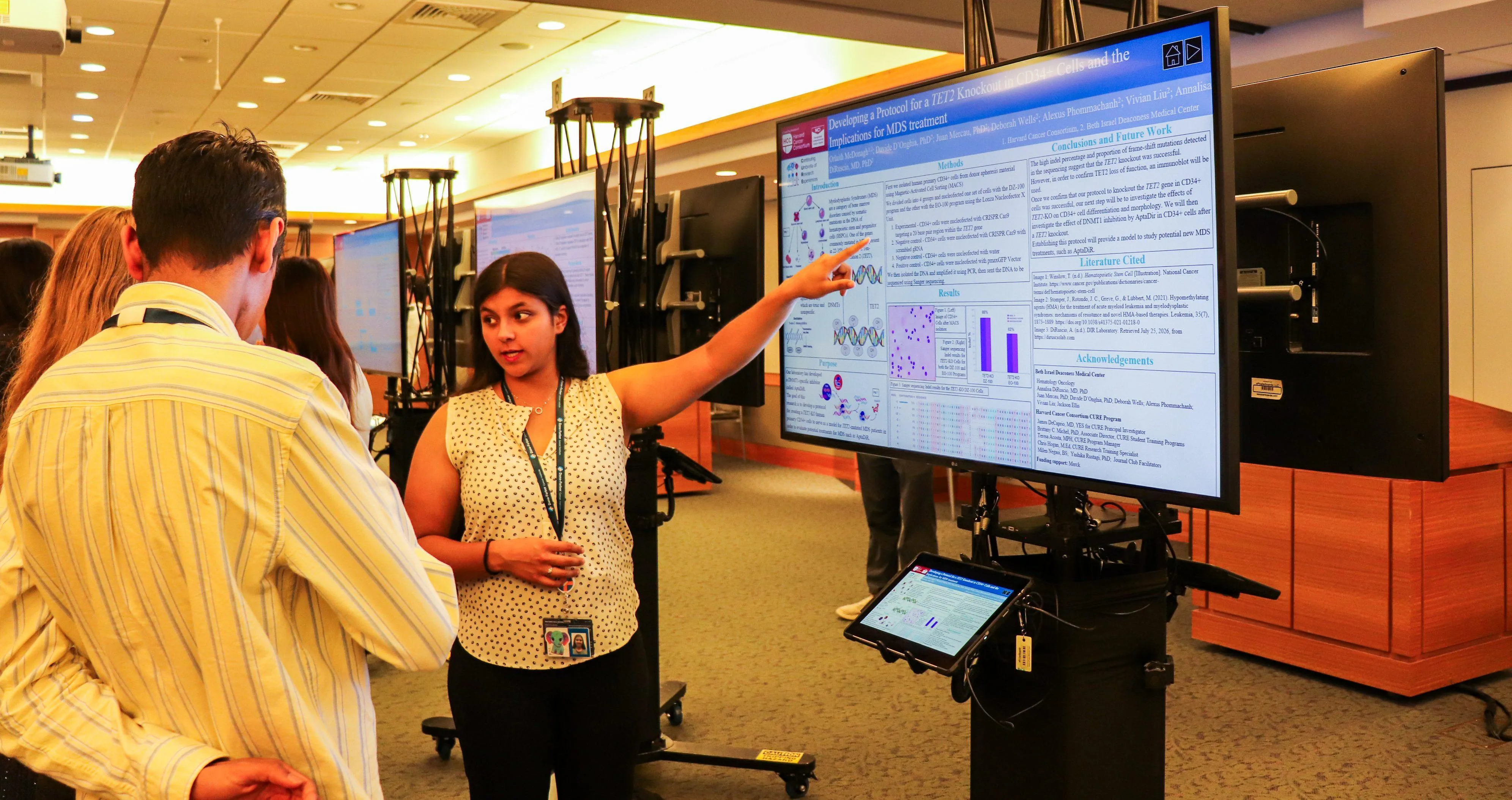
This summer's CURE cohort pursued an impressive range of cancer research projects while gaining hands-on experience in world-class laboratories across the Harvard-affiliated research community. Despite their varied backgrounds and research interests, the students shared a common enthusiasm for discovery, mentorship, and the opportunity to contribute to meaningful scientific work. We caught up with a handful of students during the oral talks and poster presentations August 4-6, which capped off their summer experience.
Cali Cahill
Cali Cahill, a rising senior at Nauset Regional High School, worked in the lab of Dr. Kent Mouw (DFCI) under mentors Dan Harbour, Yuzhen Zhou, PhD, and Yudam Chang. Her project focused on muscle-invasive bladder cancer, specifically investigating how interactions between tumor cells and immune cells may contribute to chemotherapy resistance and tumor growth. Using gene-editing techniques to alter macrophages, Cahill's work explored mechanisms that could one day lead to new therapeutic approaches for patients with aggressive bladder cancer.
Josue Venegas
At the lab of Chi-Fu Jeffrey Yang, MD (MGH), Josue Venegas, a rising sophomore at Boston College worked with mentor Quiana Guo to examine lung cancer risk prediction models and how they apply to Latino, Hispanic, and other populations of Spanish origin. His research explored how different approaches to racial and ethnic classification can affect risk assessment and potentially influence access to screening. The project highlighted the important intersection of cancer research, health equity, and population science.
Emma Foster
Emma Foster, a rising junior at Howard University, joined the laboratory of Dr. William Shih (DFCI/Wyss) focused on DNA nanotechnology and bioengineering. Mentored in her day-to-day activities by Matthew Aquilina, PhD, Julie Finkel, PhD, and Minke Nijenhuis, PhD, her research involved designing and assembling DNA-based structures with potential applications in cancer vaccines and artificial antigen-presenting cells. Foster described the excitement of seeing digital designs become real molecular structures and gained experience with cutting-edge technologies used in the rapidly evolving field of bioengineering.
Jameel McDaniel
Also from Howard University, Jameel McDaniel, a chemistry major, conducted research in the Molecular Biology Core Facilities with PI Zach Herbert, MS, and mentors Stephen Mraz, MS, and Allen Potter, MS. He evaluated a new DNA quantification technology developed by Beckman Coulter, testing its ability to accurately measure low concentrations of DNA and comparing its performance with established industry-standard instruments. His work helped assess the potential of emerging laboratory tools that support biomedical research.
Jeronimo Palacio
Jeronimo Palacio, a rising high school senior, worked in the lab of PI Jerome Ritz, MD (DFCI), with mentors Carol Reynolds, PhD, Kevin Panaro, and Casey Gervais, MS studying cellular mechanisms involved in hematopoietic cell transplantation. His project focused on investigating a newly identified subset of immune cells that may be linked to toxicities observed in transplant patients receiving a novel treatment approach. In just one summer, Palacio learned sophisticated laboratory and data-analysis techniques while contributing to an ongoing effort to better understand patient outcomes.